BEWARE...SOME DAYS ARE NOT VERY PRETTY. I GET CRABBY LIKE NORMAL PEOPLE DO. AND I DO SPEAK MY MIND.
DO NOT READ IF YOU ARE SENSITIVE TO TRUE, REAL, EVERYDAY FEELINGS LIKE MINE.(But I think you would enjoy it)
DON'T FORGET...FREEDOM OF SPEECH !
The head 'Tonight Show' writer leaves job after 7 months, vows never to do a Trump sketch 'ever again'
Jason Guerrasio
"The Tonight Show with Jimmy Fallon." NBC
The head writer of "The Tonight Show with Jimmy Fallon" has left the show after only seven months.
Becky
Drysdale wrote in a private Facebook post, obtained by the Chicago
Sun-Times, that she didn't want to do jokes involving President Donald
Trump ever again.
Drysdale said that the exit was a
mutual decision between her and the show and that "doing material about
Trump, has led to divided creative teams, anxiety, tears and pain."
Insider contacted "The Tonight Show" for comment but didn't immediately hear back.
The
head writer of NBC's "The Tonight Show with Jimmy Fallon," Becky
Drysdale, has said she is leaving the late-night show because she is fed
up with doing material involving President Donald Trump.
The exit
by Drysdale — a veteran comedian who has written for "Key & Peele"
and even starred in "Arrested Development" — was revealed in a private
Facebook post she wrote, which was obtained by the Chicago Sun-Times.
"I
am making the decision for myself to never work on, write, or be
involved with, another Trump sketch ever again," Drysdale wrote,
according to the Sun-Times.
"I have landed in several jobs and
situations over the last few years, not just 'The Tonight Show,' where
the project of making fun of Trump, or doing material about Trump, has
led to divided creative teams, anxiety, tears and pain. I can't decide
the outcome of this election, but I can make the choice for myself, to
vote him out of my creative life."
- ADVERTISEMENT -
Drysdale,
who joined "The Tonight Show" in April when Fallon was recording the
show from home, said in her Facebook post that the decision to exit the
show was mutual.
"They made it clear that I was not a good fit for
the show and I did not disagree," Drysdale wrote. "I wish it had gone
differently and I had been able to be what they needed but that is not
how it shook out."
A 2016 "Tonight Show" interview with Donald Trump, then a presidential candidate. NBC
Critics
of Trump have criticized NBC for the way it's covered Trump in the past
— all the way back when he was running for office four years ago and
was invited to be a host on "Saturday Night Live."
Fallon also
caught heat back in 2016 when he had Trump on the show and did a
generally lighthearted interview with the candidate. The interview today
is best known for the moment Fallon tussled Trump's hair.
Since
then Fallon has been more critical of the president, but Drysdale
clearly believes Fallon's show wasn't a good fit for the way she wants
to do comedy.
"I believe that comedy is a powerful tool," she
wrote in her Facebook post. "I believe that it can handle anything, no
matter how unfunny. I don't believe that making fun of this man, doing
impressions of him, or making him silly, is a good use of that power. It
only adds to his."
Insider contacted to NBC for comment but hasn't heard back ye
USPS finds 1,700 ballots in Pennsylvania mail facilities after sweep
The
U.S. Postal Service said about 1,700 ballots had been identified in
Pennsylvania at processing facilities during two sweeps Thursday and
were being delivered to election officials.
Pennsylvania Democrats Accused of Violating Election Rules, Offering Ballot Info to Party Operatives
Ryan Mills
Pennsylvania’s
Democratic election leaders violated state code on Monday when they
authorized county election officials to provide information about
rejected mail ballots to political party operatives, according to a Republican lawsuit filed in state court and obtained by National Review.
The lawsuit cites an email sent to county election directors at 8:38 p.m. on Monday by Jonathan Marks, Pennsylvania’s deputy elections secretary.
In
the email, Marks wrote that “county boards of elections should provide
information to party and candidate representatives during the
pre-canvass that identifies the voters whose ballots have been rejected”
so they could be offered a provisional ballot.
Democrats have
been winning mail-in voting handily in Pennsylvania and mail votes are
key to Joe Biden’s chances of overtaking President Donald Trump’s
dwindling lead in the state.
- ADVERTISEMENT -
Republicans
argue the direction from Marks violates the state’s election code,
which states “no person observing, attending or participating in a
pre-canvass meeting may disclose the results of any portion of any
pre-canvass meeting prior to the close of polls.”
In the lawsuit,
filed Tuesday against Secretary of State Kathy Boockvar in part by two
Republican state house candidates, the Republicans note that Pennsylvania’s supreme court stated last month
that “unlike in-person voters, mail-in or absentee voters are not
provided any opportunity to cure perceived defects (to their ballot) in a
timely manner.”
But the Republicans argue that the opportunity to
cure perceived defects for ballots that overwhelmingly support
Democrats is exactly what Boockvar and Marks were allowing. Attempts to
reach Boockvar and Marks for comment on Thursday were unsuccessful.
At
least eight counties refused to accept Marks’ suggestion that they make
voters aware of rejected ballots because doing so violates the state’s
election code, according to the lawsuit.
The Monday night email is
just one of several pieces of guidance by Democratic election leaders
that Republicans say have been inconsistent and confusing.
Lawrence
Tabas, the chairman of the Pennsylvania GOP, said high-ranking state
Democrats are using their positions to stack the deck against
Republicans and President Donald Trump.
“They constantly are
changing the rules,” he said. “They have been applying different
standards, issuing guidances as they go, changing the rules as they go,
and making it difficult for us to be able to establish that there is one
clear, uniform standard of how to do this throughout the whole
commonwealth. That’s what we want.”
Pennsylvania Republican
leaders also have complained about inconsistent guidance to county
election directors about segregating and processing mail ballots that
arrive after Election Day.
Republicans are challenging a Pennsylvania supreme court ruling that allows for all mail-in ballots that arrive by 5 p.m. on Friday to be counted.
Just last year, the Pennsylvania legislature extended the deadline for mail-in ballots to be received from 5 p.m. on the Friday before Election Day to 8 p.m.
on Election Day, the time that polls close for in-person voting. The
state supreme court’s elected Democratic majority then further extended
the deadline to the Friday after Election Day, a change the legislature
had refused to make.
In the case of a dispute about when exactly a
ballot was postmarked, or if it wasn’t postmarked at all, the state
supreme court ruled that election officials are required to assume it
was sent in by Election Day rather than rejecting it, as done under
existing state law.
In early October, the U.S. Supreme Court
deadlocked on the case, but left open the possibility that the Court
could reconsider it.
Pennsylvania officials have urged county
election directors to keep late-arriving ballots segregated, but
Republicans have said the instructions have been confusing.
State
Senate majority leader Jake Corman said at a Wednesday press conference
that he believed the State Department has been “weaponized” and
influenced by partisan efforts to sway the vote, the Pittsburgh Post-Gazette reported.
“All we want to do is have confidence in the result,” Corman said, according to the Post-Gazette.
“We’ll have winners and we’ll have losers, but it seems to be the
mission of the Democratic Party to cause confusion in this race.”
Boockvar responded that the state’s guidance has been clear.
“They
don’t like the late counting of ballots because they don’t like
anything that allows more eligible voters to be enfranchised,” she told
the paper.
Tabas worries that without clear guidance about how to
process late-arriving ballots, they could be co-mingled with ballots
received by Election Day. That could be a problem if the Supreme Court
rules that only ballots received by Election Day should count in the
final tally.
“There was no clear indication as to how, during that
processing, they could remain segregated so we could identify later
which ones came in late and are included in the total or not,” he said.
Winning
Pennsylvania is key for Trump to have any chance of holding the
presidency. He was ahead by about a half-million votes Wednesday, but
Biden has cut into his lead as more absentee ballots are counted.
Trump’s lead was down to about 100,000 votes on Thursday afternoon.
Tabas
said it’s not clear how many outstanding ballots have yet to be
canvassed and counted, and it’s not clear how many ballots actually did
arrive after Election Day.
He said he remains optimistic about
Trump’s chances in the Keystone State, even though many elections
experts are projecting that Biden will ultimately pull ahead.
Tabas
said Trump “has done very well throughout the state, and part of our
confidence and hope and optimism is, our statewide candidates are doing
very well.”
“We’ve had greater turnout than expected in our
strongholds on Election Day,” he said. “We’ve exceeded our expectations,
in some cases very dramatically. Right now we are just waiting to see
what is left to be counted and that the rules are being applied equally
and uniformly.”
In addition to the lawsuit over ballot counting
and the lawsuit over alleged violations of the state’s election code,
the Trump campaign also has said it filed a lawsuit in Pennsylvania
because its poll watchers have not been actually able to observe ballot
counting.
During a press conference Wednesday in Philadelphia,
Rudy Giuliani, Trump’s personal lawyer, said poll observers are being
kept so far back that they are “never able to see the ballot itself,
never able to see if it was properly postmarked, properly addressed,
properly signed on the outside, all of the things that often lead to the
disqualification of ballots, or make it very easy to dump 50,000
totally fraudulent ballots because they’re not observed.”
“Not a
single Republican has been able to look at any one of these mail-in
ballots,” Giuliani said. “They could be from Mars as far as we’re
concerned, or they could be from the Democratic National Committee. Joe
Biden could have voted 50 times as far as we know, or 5,000 times.”
Aaron
Coleman, a 20-year-old progressive Democrat, won Tuesday's election to
represent Kansas' 37th District in the state House of Representatives.
Coleman's
campaign has ben plagued by scandal. In June, he admitted to spreading
revenge porn and harassing girls online when he was 14, and in July, he
made insensitive comments about the COVID-19 pandemic.
While
Coleman initially dropped out of the race after beating seven-term
incumbent Stan Frownfelter in an August primary, he decided two days
later to continue his campaign.
However, Coleman had by
then lost support of the state's Democratic Party, which scrambled to
find a replacement, which included backing a write-in campaign for
Frownfelter.
On Election Day, Coleman ran unopposed in
the Democratic stronghold district, winning 3,496 of the votes. More
than 2,000 write-in votes were cast, but it's unclear what names were
submitted.
The 20-year-old Democrat who earlier
admitted to circulating revenge porn and harassing girls online in
middle school has won a seat in the Kansas state House of
Representatives.
Aaron Coleman has won a seat in the Kansas state House of Representatives. Aaron Coleman for Kansas/Facebook
Aaron Coleman, a dishwasher and community college student, ran unopposed in Kansas' 37th District, which encompasses part of Kansas City.
Coleman won Tuesday's election with 3,496 votes, KSHB reported. More than 2,000 write-in votes were counted, but it's unclear what names were submitted.
In
June, Coleman admitted to allegations that he bullied and threatened
girls online when he was 14 years old, including calling one girl fat
and saying she should kill herself, and circulating a nude image of
another girl when she refused to send him more pictures, according to The New York Times.
In July, he was also widely criticized for making insensitive comments about the COVID-19 pandemic. According to the Kansas Reflector, Coleman mocked the death of former GOP presidential candidate Herman Cain -- who died of the coronavirus -- and said he would "giggle" if former state GOP Rep. John Whitmer caught the virus and died. Coleman later apologized for his comments.
Despite
the scandals, Coleman beat seven-term incumbent Stan Frownfelter, also a
Democrat, in the August primary, albeit by a narrow 14 votes.
Coleman apologized for the bullying and revenge porn in a statement to The Kansas City Star after winning the primary.
"I
made serious mistakes in middle school and I deeply regret and
apologize for them. I've grown up a great deal since then," Coleman
said.
Coleman actually dropped out
at one point after the primary, but continued with the campaign two
days later, saying the fact that he won even with his background was a
strong message from voters.
"They said that they did not vote for
me expecting that I was a perfect person," he said in a statement on
Twitter, according to The Hill. "They told me that all of us have sinned, and we all make mistakes."
"Voters
do not throw out a 7-term incumbent for a person like myself unless
they are deeply frustrated with their lack of representation and
demanding a change."
The state Democratic party scrambled to
present an alternative candidate, backing a write-in campaign for
Frownfelter, KSHB reported.
On Wednesday, Coleman tweeted: "Thank
you to all of my supporters. This campaign would not have been possible
without you. I promise to work hard to serve the residents of this
district."
Our
goal is to create a safe and engaging place for users to connect over
interests and passions. In order to improve our community experience, we
are temporarily suspending article commenting.
U.S. District Judge Emmet Sullivan was furious
Wednesday that the U.S. Postal Service had defied his order to sweep
postal processing facilities in 15 states Tuesday to find missing
absentee ballots and deliver them on time. The USPS had said in a court
document that 300,000 ballots had been scanned into facilities but not
scanned out, suggesting they were misplaced.
Instead of complying
with Sullivan's order, the USPS kept to its own schedule, raising
concerns that tens of thousands of ballots would not be delivered in
time to be counted. "It just leaves a bad taste in everyone's mouth for
the clock to run out — game's over — and then to find out there was no
compliance with a very important court order," Sullivan said. He suggested he would demand a deposition from Postmaster General Louis DeJoy.
Notably,
there were 81,000 untraced ballots spread across postal districts in
key swing states with a combined 151 electoral votes, The Washington Post reports,
though, according to its analysis, the missing ballots "are unlikely to
affect the outcome of the presidential race." In many cases, USPS said,
the ballots had been hand-sorted and delivered without an exit scan.
The USPS did not provide data to indicate how prevalent that practice
has been, though it did disclose that 7 percent of ballots in its
sorting facilities Tuesday were not delivered in time to be counted.
"Even
in a worst-case scenario where all potentially misplaced ballots in a
state are permanently lost, those ballots amount to just a fraction of
both current two-party vote margins and estimates of the number of
outstanding ballots yet to be tallied," the Post reports.
In Georgia, for instance, the maximum 6,624 missing votes represent
just 8 percent of the margin between President Trump and Democrat Joe
Biden.
- ADVERTISEMENT -
In other states, though, the number of missing ballots is larger
— more than 11,000 in Pennsylvania and 16,000 in Florida — and the
untraced absentee votes in Arizona make up 24 percent of the outstanding
margin between Biden and Trump, the Post reports.
Also, its analysis that "misplaced mail ballots will not be a
significant factor in final vote tallies" has the caveat that it might
be a factor if "the final presidential vote margins shrink to low three-
or four-digit numbers in the coming days." In some states, like Arizona and Georgia that's a distinct possibility.
USPS's handling of mail-in ballots was 'gross negligence': Fmr. USPS Board of Governors Chair
Former
USPS Board of Governors Chair David Fineman joins Yahoo Finance's
Kristin Myers to discuss the postal service's handling of mail-in
ballots.
“The assumption that there are unaccounted
ballots within the Postal Service network is inaccurate. These ballots
were delivered in advance of the election deadlines. We employed
extraordinary measures to deliver ballots directly to local boards of
elections." - USPS
WASHINGTON
(Reuters) - The U.S. Postal Service (USPS) said about 1,700 ballots had
been identified in Pennsylvania at processing facilities during two
sweeps Thursday and were being delivered to election officials.
In
a court filing early Friday, USPS said 1,076 ballots, had been found at
the USPS Philadelphia Processing and Distribution Center. About 300
were found at the Pittsburgh processing center, 266 at a Lehigh Valley
facility and others found at other Pennsylvania processing centers.
Ballots
must be received by Friday evening in Pennsylvania in order to be
counted. The vote for the U.S. president remains extremely close and
Pennsylvania is one of the states that remains undecided.
About 500 ballots were also discovered in North Carolina during sweeps, USPS said on Friday.
U.S.
District Judge Emmet Sullivan on Thursday had ordered twice daily
sweeps at USPS facilities serving states with extended ballot receipt
deadlines as votes were still being counted in U.S. election
battleground states.
Some states, including Nevada and North
Carolina, are counting ballots that are received after Election Day as
long as they were postmarked by Tuesday.
Lawyers said at a court hearing on Thursday that USPS had delivered about 150,000 ballots on Wednesday.
"The vast majority were destined for postmark states and would be delivered on-time under state election law," USPS said.
Sullivan
said the processing centers must perform morning sweeps and then
afternoon sweeps "to ensure that any identified local ballots can be
delivered that day."
Sullivan issued a separate order requiring
USPS to "coordinate with all local county Boards of Elections in North
Carolina or Pennsylvania" in order to deliver all ballots "before 5:00
PM local time in North Carolina or Pennsylvania" on Friday.
Ballots
were still being counted by election officials in battleground states
after polls closed Tuesday in one of the most unusual elections in U.S.
history because of the novel coronavirus pandemic.
Democratic
candidate Joe Biden was cutting sharply into Republican President Donald
Trump's leads in Pennsylvania and Georgia. The former vice president
retained slim margins in Nevada and Arizona.
(Reporting by David Shepardson; Editing by Christian Schmollinger, Robert Birsel)
Two of basketball’s biggest stars have been chipping in to help Florida felons vote in this year’s election.
LeBron
James and Michael Jordan helped join Michael Bloomberg’s $27 million
effort to help clear fines and fees for about 40,000 felons in the state
so that they can vote in Tuesday’s election, according to the Tampa Bay Times.
It’s not clear how much they contributed. Spokespeople for both Bloomberg and James’ “More Than A Vote” organization did not return the Times’ requests for comment.
Bloomberg enlists celebrities to help Florida felons
James and Jordan are just the latest to help pitch in and assist Florida felons vote in this year’s election.
About
1.4 million Floridians had their right to vote restored in 2018 thanks
to Amendment 4, which allowed convicted felons who have served their
sentences to vote again — with the exception of murder or sexual abuse.
Last
year, however, Republican lawmakers and the governor passed a law that
required ex-felons to pay back court fines and fees before regaining
their right to vote — which is essentially a poll tax and was found to
be unconstitutional in May.
An appeals court ruling earlier this
year overturned that unconstitutional ruling. Five of the six votes that
overturned that ruling, according to The New York Times, came from judges who were appointed by President Donald Trump.
About
75 percent of former felons owe court debt, and about 70 percent of
them are unable to pay. There is no central database used in the state,
either, making paying those fees extremely difficult if not impossible.
According to the Tampa Bay Times,
about 32 percent of the 4,700 felons who had their rights restored
through Bloomberg’s foundation in the states four biggest counties had
registered to vote.
A
$27 million effort led by Michael Bloomberg, LeBron James, Michael
Jordan and others helped Florida felons vote on Tuesday. (Mike
Ehrmann/Getty Images)
Local Police Say Biden Staffer May Have Been ‘At Fault’ in ‘Trump Train’ Highway Incident
Mairead McArdle
Local police in Texas
said over the weekend that the vehicle of a Joe Biden staffer may be
“at fault” in a minor collision that occurred during an incident where
Trump supporters in trucks surrounded and followed a Biden campaign bus.
The
incident occurred on I-35 in Hays County and involved a Biden staffer’s
white SUV making contact with a Trump supporter’s black truck.
The San Marcos Police Department, which is handling any potential police reports on the crash, said it has researched the collision and watched footage of the incident online.
“The
at-fault vehicle may be the white SUV and the victim appears to be the
black truck,” the police department said in a statement.
- ADVERTISEMENT -
“Calls
to the driver of the white SUV have gone unanswered and SMPD has not
been contacted by the driver of the black truck. Since SMPD has not
spoken to either driver at this time, additional investigation would be
required to fully ascertain who was at fault,” the department said.
The
police department also said the Biden bus requested a police escort,
but due to traffic police were not able to reach the campaign bus before
it exited the jurisdiction.
Katie Naranjo, chair of the Travis
County Democratic Party said in a tweet that Trump supporters followed
the Biden bus through central Texas “to intimidate Biden supporters.”
“They ran into a person’s car, yelling curse words and threats. Don’t let bullies win, vote,” she wrote.
The Biden campaign also condemned the group of Trump supporters, accusing them of endangering those close to the campaign.
“Rather
than engage in productive conversation about the drastically different
visions that Joe Biden and Donald Trump have for our country, Trump
supporters in Texas instead decided to put our staff, surrogates,
supporters, and others in harm’s way,” said Tariq Thowfeek, the Biden campaign’s Texas communications director.
President
Trump on Saturday tweeted a video that appears to show his supporters
surrounding the bus along with the words “I LOVE TEXAS!”
The
nonpartisan Cook Political Report on Wednesday moved the presidential
race in Texas from “lean Republican” to “toss up.” Trump is up by one
point in the state as of Tuesday, a day before the election, according to the Real Clear Politics average of polls.
Across
the country, cases of COVID-19 are increasing at an alarming pace. In
the last seven days, more than 500,000 people were diagnosed with
COVID-19, according to the Centers for Disease Control and Prevention. And a growing number of people have no idea how they contracted the virus, doctors say.
“It’s
increasingly becoming common” for patients to not know how they got
COVID-19, Dr. Amesh A. Adalja, a senior scholar at the Johns Hopkins
Center for Health Security, tells Yahoo Life. Dr. Richard Watkins, an
infectious disease physician and professor of internal medicine at the
Northeast Ohio Medical University, agrees. He tells Yahoo Life that
“lately, most of” his patients don’t know where they contracted the
virus. The same is true for Dr. Rajeev Fernando, an infectious disease
expert in Southampton, N.Y. For many of his patients, “it’s because
people tell me they’ve not been wearing masks as they should,” he tells
Yahoo Life.
This trend says a lot about the virus and where things
are headed, Dr. William Schaffner, an infectious disease specialist and
professor at the Vanderbilt University School of Medicine, tells Yahoo
Life. “The virus can spread from people who have no symptoms or who are
asymptomatic,” he says. “It’s now spreading in a way that people
experience when they get the common cold. They wonder, ‘Where did I get
that?’ and it can be difficult to really know the answer. This is an
indication of how widely spread the virus has become in our
communities.”
An
attendant talks to a person in line at a coronavirus testing site at
Ascarate Park on Saturday in El Paso, Texas. Doctors say a growing
number of people have no idea how they contracted the virus. (Cengiz
Yar/Getty Images)
Henry F. Raymond,
associate professor and epidemiologist at the Rutgers School of Public
Health, tells Yahoo Life that the increase in people who don’t know how
they contracted COVID-19 indicates that “there are a lot of asymptomatic
spreaders.”
“It’s no longer obvious, like you were with a friend,
they looked bad and they sneezed on you,” he says. “We’re definitely
seeing a lot of younger people who are asymptomatic, carrying the virus
and spreading it.”
At the same time, “many people don’t understand
how contagious the coronavirus is,” Watkins says, adding, “this,
combined with the high number of asymptomatic infected people, is what
is driving the pandemic, which is not showing signs of slowing. We are
definitely not ‘turning a corner.’”
Not knowing how you caught the
virus can make it difficult for contact tracers to figure out patterns
in transmission, Raymond says. It’s not entirely cut and dry, though.
“In
some ways it’s easier, in some ways it’s harder,” Adalja says. “If you
don’t know who you got the virus from, it’s hard to find patterns with
contact tracing.” But people are increasingly spending time in smaller
groups, which can make it easier for contact tracers to know who to
contact next, he says. “If you have only been around three people, it’s
easier to know who are your contacts,” Adalja says.
The rise of contact tracing apps like New York’s COVID Alert NY and Pennsylvania’s COVID Alert PA
may help, but it’s too soon to know how much they can contribute,
Raymond says. “It’s too early to tell how many people are actually going
to download them and activate them to see what impact it might have,”
he says.
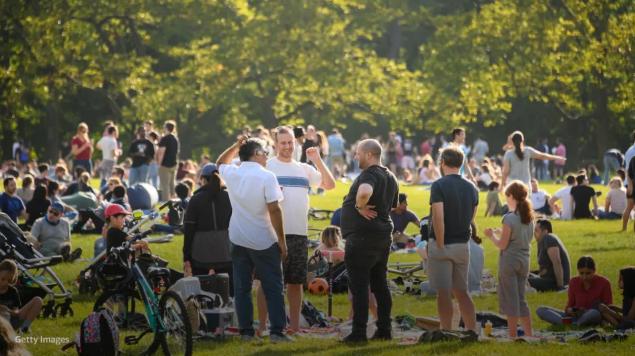
The trend toward people hosting others in their own homes
as the weather cools is concerning to Adalja. “It’s harder to intervene
in what people are doing in their own homes versus in mass gatherings
or at a restaurant. It’s much more difficult to come up with a plan for
people to follow.”
That’s why Adalja recommends that people remain
“really vigilant” about how they’re acting when they’re around others.
In addition to following the CDC’s guidelines
for preventing the spread of the virus, like wearing masks, practicing
social distancing and washing hands regularly, Adalja urges people to
think about their potential exposure at home. “If you can see other
people outdoors instead of indoors and keep your distance, that’s
better,” he says. “I suspect that people are not going to be wearing
face coverings in their own home.”
Raymond stresses that people
should be aware that current case counts of the virus are “just the tip
of the iceberg,” adding, “in general, the amount of virus in the
community is much higher than people realize.” There are “probably
thousands who are, on some level of the spectrum — maybe they feel achy
but they don’t get a test, or they don’t feel bad at all but they’re
spreading the virus — and they’re not being counted,” Raymond says.
Raymond
urges people to be aware that the pandemic is still ongoing, and that
it’s getting worse. “We are in this for a longer time than we ever
hoped,” he says. “Now is not the time to think that the fight is over.”