BEWARE...SOME DAYS ARE NOT VERY PRETTY. I GET CRABBY LIKE NORMAL PEOPLE DO. AND I DO SPEAK MY MIND.
DO NOT READ IF YOU ARE SENSITIVE TO TRUE, REAL, EVERYDAY FEELINGS LIKE MINE.(But I think you would enjoy it)
DON'T FORGET...FREEDOM OF SPEECH !
Speaking
on Tuesday, the president-elect said he and vice president-elect Harris
had taken Covid-19 vaccines publically to “instill confidence” in them,
when he misspoke.
Ms Harris had received her vaccine dose
publicly some hours earlier, as American lawmakers and officials try to
build public trust in the vaccine programme.
- ADVERTISEMENT -
“I
took it to instill confidence in the vaccine,” said Mr Biden, who was
speaking from Wilmington, Delaware. He received a vaccine dose last
week, also live on air.
“President-elect Harris took hers today
for the same reason,” he then added, while accidentally referring to his
running mate as the president-elect.
The 78-year-old has made the
same mistake in the past, saying on the campaign trail several months
ago that there would be a “Harris administration”.
Mr Biden, who
will assume the United States presidency on 20 January, went on to warn
that vaccines were being rolled-out too slowly by the Trump
administration.
And at the current pace, said the president-elect, “it’s gonna take years, not months, to vaccinate the American people.”
“As
I long feared and warned the effort to distribute and administer the
vaccine is not progressing as it should,” he added, while warning that
“things will get worse before they get better”.
According to the
Centers for Disease Control and Prevention (CDC) on Tuesday, around 11.4
million vaccine doses have been distributed.
Viral
video of Chicago house party reveals disconnect between black youth and
media during coronavirus. ‘Dialogue needs to happen about what we’re
going to do to keep black Americans alive.’
House parties are meant to be a thing of the past now that COVID-19 has turned into a pandemic.
But on April 25, a viral video showed a gathering of dozens
of people in the Northwest Side neighborhood of Galewood at a memorial
party for two friends who died of gun violence years ago. The video drew
such a level of nationwide vitriol on social media that Mayor Lori
Lightfoot blasted the revelers as “foolish and reckless,” and Gov. J.B.
Pritzker criticized the partygoers for “putting everyone around you in
danger.” (Tribune columnist, Dahleen Glanton,
wrote an open letter to the black kids who partied, citing the reality
of killing loved ones “without even knowing that you are carrying a
weapon.”) Chicago police have subsequently said they cited the homeowner
with disorderly conduct Monday.
A screenshot from the now viral Chicago house party in city's Galewood
neighborhood that occurred during the stay at home order. (YouTube)
With so much conversation about the event, The Triibe, a digital media
platform that tells stories of black Chicago, sought to find the
disconnect between local government officials, black youth and
traditional media outlets in conveying the serious nature of the
coronavirus. In her article, Veronica Harrison (aka Vee L. Harrison),
talks to a young woman at the party. The woman told Harrison she knows
COVID-19 is serious, but she’s not letting fear win out over her faith.
The partygoer told Harrison: “I get irritated with these celebrities
trying to tell us to stay in the house. Us people that aren’t as rich as
them, we don’t have nothing to do in the house. Sometimes this can
cause you to go into boredom and depression and you have to get out, you
have to get some air.”
Harrison said her phone has not left her hand since the Triibe story went live Tuesday night.
“The story’s momentum, we did not expect, and such vivid conversations
and the range of responses between age and socioeconomic categories,”
she said. “I believe that we are in a space and time where the
generational divide and the poison in that is really plaguing our
country, literally killing us. Because we can’t see eye to eye, it’s
hard to understand how people are surviving this. ... The boomers want
to blame the millennials and the millennials want to blame the folks
underneath them. We’re doing a lot of finger-wagging and we’re not
coming up with solutions and keeping people alive.”
Illinois State Rep. LaShawn Ford, in an attempt to find solutions, held
a Facebook Live conversation on Tuesday with the host of the house
party, Janeal Wright, 26. The intervention was seen as a teachable
moment, according to Ford. He supports Wright, even though he said it
wasn’t a popular move, because supporting him will make sure that he
doesn’t do something like it again when social distancing is necessary.
It’s all in the vein of “if you know better, you do better.”
“He’s a good young man; he just made a bonehead decision,” Ford said in
a phone interview. “Look, if the president of the United States can
make the stupid comments about bleach and
Lysol injecting and the vice president can go into a hospital without a
mask, but this young man who is less than a third of their age and
doesn’t have the experience that they have, we’re going to nail him? No.
Absolutely not. We’re going to help him and he’s going to be better
from it and we’re going to connect with the young population and not
further divide us with them.”
Ford said he and Wright are working on pointing party attendees to get
tested for the coronavirus at Loretto Hospital. Ford said he’s working
on creating a video with Wright to get the message out to the young
population about the importance of adhering to the stay-at-home order
and maintaining social distancing.
During the Facebook Live conversation, Wright told Ford that he, like
most young people, doesn’t watch the news because there’s a lot of talk
about people of color getting killed. Young people disengaged with the
news is one form of the disconnect between black youth and traditional
mediums of communication, says Harrison.
Sona Smith, executive director at Illinois Caucus for Adolescent Health,
says residents in typically under-resourced communities were already in
survival mode prior to COVID-19, and the virus just adds another layer
that may seem less immediate.
“There is a historical and deep seated distrust that we have with
things related to government, the medical system, policing — you name
it,” said the Bronzeville resident. “The Lori Lightfoot memes and things
like that makes (coronavirus) more relatable and it connects to the
younger audience, but there’s so much healing that needs to take place
between all the people within those marginalized communities and these
systems that now we have to trust; that we have to rely on for our
updates and to tell us what to do next.”
Smith said trust doesn’t come because we are in the middle of a
pandemic. “You can get the message out in a million different avenues,
but if the people don’t trust the source of that message, it’s not going
to resonate.”
Ford saw the Facebook discussion as an opportunity to turn a negative
into a positive and to give youth like Wright and his partygoer friends a
voice. Harrison said she is brainstorming with people like Ford to
build a coalition to give black youth a place to vent their concerns,
since what exists now seems to be missing the mark.
Harrison said her article’s goal was to create a conversation.
It did.
“It’s creating this narrative that people were either afraid to
approach or people haven’t thought about, and, either way, I’m good with
that,” she said. “If we don’t move the needle in how we’re sharing
these stories, we’ll continue to lose lives specifically in Chicago,
specifically in black communities. I think right now, dialogue needs to
happen about what we’re going to do to keep black Americans alive.”
Black Women Democrats Are Pushing Joe Biden to Cancel $50,000 of Loan Debt per Borrower, Citing Increasing Racial Inequality
Anne Branigin
As
the nation waits for congressional lawmakers to reach a resolution on a
second stimulus bill—nine months after the coronavirus pandemic began
disrupting the lives of Americans around the country—a group of Black
female House Democrats is challenging President-elect Joe Biden to offer
more substantial relief to student loan borrowers.
The charge
comes in the form of a resolution, introduced by Reps. Ayanna Pressley
(D-Mass.), Ilhan Omar (D-Minn.), Alma Adams (D-NC) and Maxine Waters
(D-Calif.), reports Vox.
The resolution calls for the incoming Biden administration to take a
more aggressive stance on cutting student loan debt by forgiving up to
$50,000 in federal debt for student borrowers. A companion piece to a
Senate resolution put forward by Sens. Chuck Schumer (D-NY) and
Elizabeth Warren (D-Mass.) earlier this year, the resolution makes the
case that student debt forgiveness is a critical tool in tackling racial
inequality.
“The
student debt crisis is a racial and economic justice issue and we must
finally begin to address it as such,” Pressley said in a statement.
“Broad-based student debt cancellation is precisely the kind of bold,
high-impact policy that the broad and diverse coalition that elected Joe
Biden and Kamala Harris expect them to deliver.”
- ADVERTISEMENT -
Pressley
argued that canceling student debt is “one of the most effective ways
to provide direct relief to millions, help reduce the racial wealth gap,
stimulate our economy, and begin to deliver an equitable and just
recovery.”
Waters,
chairwoman of the House Finance Committee, echoed the need for debt
forgiveness amid a pandemic and a lagging economy that has seen massive
job losses.
“I cannot overstate the importance of this resolution
and the need for the Biden Administration to take bold action and
deliver on this mandate from the people on day one,” said Waters.
As The Root
has reported over the years, student loan debt disproportionately
affects African American borrowers. The reasons are myriad: A 2016 Atlantic
article found Black grads had less debt compared to their non-Black
peers shortly after receiving their undergraduate diplomas. However,
their debt ballooned in the years after. Four years after graduating,
Black grads saw nearly double the amount of debt of white, Asian and
Latinx students.
This is in part because more Black graduates
continue their studies after receiving their bachelor’s degree, and
because they have a higher rate of attending predatory for-profit
institutions, which put them further in debt without actually advancing
their employment options. Graduates of historically Black colleges and
universities have also been found to accrue higher debt burdens than those who do not attend HBCUs.
Undergirding all of this is an increasingly disparate racial wealth gap, made possible in part by what National Employment Law Project Director Rebecca Dixon describes to The Root as a “Jim Crow job market,” in which Black workers disproportionately work lower-wage jobs than their white counterparts and—particularly for Black women—are paid less than their peers in those professions.
“Student
debt cancellation would be a massive economic stimulus at a time when
people desperately need it. It’s also a racial equity issue. Students of color
are more likely to take out federal student loans, and face higher
rates of default,” pointed out Rep. Omar, who worked with Pressley
earlier this on a plan to drastically reduce student debt.
“Over
90 percent of student debt is held by the federal government, which
President-elect Joe Biden can cancel with the stroke of a pen,” said
Omar.
As Vox notes, Biden has supported legislation to cancel
$10,000 in federal student loan debt, but lawmakers and activists who
helped put him in office are urging the president-elect to forgive
greater amounts of student debt—if not canceling it entirely.
Those
who oppose student debt forgiveness say such a policy wouldn’t actually
help the people who most need it, citing that much of America’s student
loan debt is held by households with graduate degrees, as the Brookings Institution
found. Policy experts also note that student loan forgiveness alone
cannot fix wealth and educational inequity, but must be coupled with
larger changes to higher education in order to prevent upcoming
graduates from sliding back into debt again.
But those reasons are
not enough to deny debt relief to millions of Americans who desperately
need it, say proponents of student debt forgiveness. Rep. Adams pointed
out that this debt has stymied the purchasing power and mobility of
many Americans.
“These loans are holding American families back
from buying houses, cars, and opening small businesses,” she continued.
“Student loan debt prevents young families from building and creating
wealth that they can pass down to their children and grandchildren—a
freedom that historically has been denied to Black Americans in this
country.”
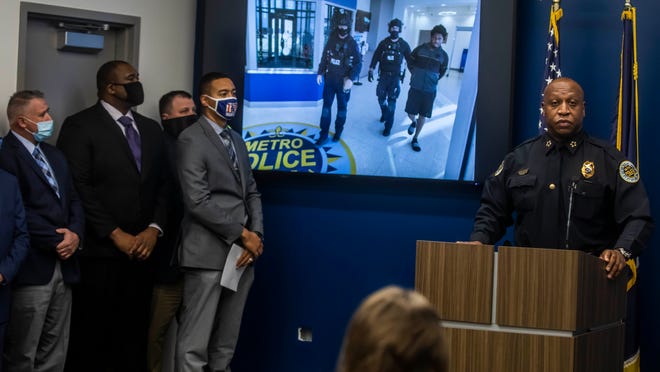
A tip from a concerned citizen provided a pivotal break in a homicide case Friday that unnerved Nashville for nine days.
At dawn, members
of Metro Nashville Police Department’s SWAT team descended on an East
Nashville apartment complex and made an arrest in the fatal shooting of a
Nashville nurse who was driving to work when police say someone opened
fire on her SUV.
Devaunte Lewis Hill, 21, was taken into custody at 6:15 a.m. in the Dec. 3 slaying of 26-year-old nurse Caitlyn Kaufman, who worked in the intensive care unit at Saint Thomas West Hospital.
Nashville
police Chief John Drake said Hill, a Nashville native, was arrested
without incident at his Porter Road home in Berkshire Place Apartments.
Hill was charged with criminal homicide in Kaufman's evening slaying along Interstate 440 west in Nashville.
According
to an arrest affidavit, on Thursday a concerned citizen told police
they had information about the killing and identified Hill as the
person who shot Kaufman. It goes on to state the person also told police
about the possible whereabouts of the gun used in the shooting.
No
other suspects have been named in the case. Homicide Detective
Christopher Dickerson told reporters Friday morning that investigators
had not ruled out the possibility of more suspects or arrests.
"I
have a gamut of emotions right now, but I’m so relieved," Kaufman's
mother, Diane Kaufman, told The Tennessean by phone late Friday morning.
"A part of me is so relieved they got him. I just get chills every time
I think about it."
Dickerson
said he swore out an arrest warrant early Friday morning after getting
the tip from the concerned citizen. The unidentified person also
provided information about a gun that police later matched to three 9 mm
shell casings found at the crime scene.
Investigators said data from Hill's cell phone provider placed his phone in the I-440 area at the time of the shooting.
Dickerson
said Hill consented to an interview after he was taken into custody and
implicated himself in the slaying. He did not elaborate on what Hill
told police.
The detective said Hill was a stranger to Kaufman.
"I can confirm they did not know each other," Dickerson told reporters during a news conference at MNPD headquarters.
As of Friday, a motive in the killing had not been released publicly.
"While
it was a relief to be able to sign the arrest warrant, it was an
exceptional relief to be able to call Diane Kaufman, who is back in
Pennsylvania right now," Dickerson said. "She said that she was able to
get some closure before the funeral. I’m glad to be in the position we
are this morning."
“I
understand many of the persons involved in the rewards are dads who
have families in Nashville and love Nashville deeply, and I thank them
for their contribution," Drake said.
'My family will forever be grateful'
"If
it weren’t for the generosity of the Nashville community I fear it
wouldn't have ever happened this quickly," Diane Kaufman told The
Tennessean. "My family will forever be grateful to them, and Detective
Dickerson, Chief Drake and Don Aaron. I think I’m still in shock. I was
in shock with the shooting, but now I’m in shock with the arrest. I’m
just so thankful."
After
the slaying, Kaufman's mother traveled to Nashville from the family's
hometown in Western Pennsylvania to meet with detectives and plead with
the public for help in finding her daughter's killer.
"Please
help me find out who did this to my daughter," she said Monday
afternoon. "I need closure. Caitlyn was selfless.... She had a
contagious laugh. She had beautiful blue eyes, a heart of gold."
Police spokesman Don Aaron said homicide detectives have been working the case relentlessly since Kaufman died.
Detectives
believe the shooting happened sometime between 6:05 and 6:10 p.m. while
Kaufman was on her way to work for a shift that began at 7 p.m. Police
say the person who killed her fired at least six shots fired into her
Mazda CX-5 SUV.
Just
before 9 p.m., a Metro Parks officer said he saw her SUV on the right
shoulder of I-440 in between the West End Avenue and Hillsboro Road
exits. The vehicle was against the guard rail so police said he stopped,
thinking he'd come upon a single-car crash.
A medical examiner determined a single bullet that struck her shoulder and that she died within seconds of being hit.
Online
records show Hill was booked into the Davidson County Jail just before
9:30 a.m. and was being held without bond. Police said Hill has a
criminal history but would not elaborate.
Saint Thomas West Hospital released a statement after learning of Hill being charged.
"We
are hopeful that justice for Caitlyn's family will be served following
the announcement that a suspect has been arrested as part of the ongoing
investigation," the statement reads. "Those who knew Caitlyn Kaufman
witnessed the overwhelming compassion and kindness she showed for each
person she cared for and worked alongside."
A memorial service for Kaufman is set in her hometown for 7 p.m. Saturday.
Natalie
Neysa Alund is based in Nashville at The Tennessean and covers breaking
news across the south for the USA TODAY Network. Reach her at
nalund@tennessean.com and follow her on Twitter @nataliealund.
21-year-old arrested in Nashville nurse slaying: Police
EMILY SHAPIRO
A
21-year-old man was arrested Friday morning in the slaying of Nashville
nurse Caitlyn Kaufman, who was shot dead while driving to work, police
said.
Devaunte Hill was arrested at his East Nashville apartment
and is being charged with criminal homicide, Nashville Police Chief John
Drake said at a Friday news conference.
"Hill gave a statement implicating himself in Caitlyn's murder," Drake said.
Hill did not know Kaufman, Drake said.
Kaufman, 26, was shot and killed on Dec. 3
while driving her gray Mazda SUV on I-440, the Metro Nashville police
said. Kaufman was on the way to St. Thomas West Hospital for a 7 p.m.
shift, police said.
Drake
said the "major break" came after Nashville business owners offered a
reward and a "concerned citizen" came forward Thursday afternoon
identifying Hill as a suspect.
The concerned citizen gave
information about the weapon and the gun was recovered Thursday night,
Drake said. Ballistics experts found it to be a match to the scene,
Drake said.
The investigation is ongoing and police said they are not ruling out the possibility of additional arrests.
St.
Thomas Hospital West said Kaufman "was a dedicated and much loved
member of our MICU [medical intensive care unit] team and a courageous
healthcare hero who was graciously called to serve our patients with
compassion and kindness."
Black Farmers, Civil Groups ‘Enraged’ After Joe Biden Selects Tom Vilsack Over Rep. Marcia Fudge to Head USDA
Anne Branigin
Black
farming and civil rights groups are giving President-elect Joe Biden an
earful about his decision to bring former Iowa governor Tom Vilsack
back to head up the U.S. Department of Agriculture, a job he held for
eight years under former President Barack Obama. According to Politico,
leaders of farming and civil rights organizations say Vilsack’s
inconsistent record on civil rights have disqualified him for the role,
which is charged with overseeing programs supporting the nation’s
farmers, providing crucial food assistance programs, and managing the
agency’s $146 billion budget. The outlet writes that the decision has
“enraged many farmers of color.”
“Vilsack is not good for the
agriculture industry, period,” Michael Stovall, founder of Independent
Black Farmers told Politico. IBF is a coalition of Black growers and
producers from Southern states that works to raise awareness on the
issues Black farmers face. “When it comes to civil rights, the rights of
people, he’s not for that. It’s very disappointing they even want to
consider him coming back after what he has done to limited resource
farmers and what he continues to do to destroy lives.”
Vilsack’s
selection was announced this week, after Ohio Congresswoman Marcia
Fudge and high profile members of the Congressional Black Caucus spent
weeks publicly lobbying for Fudge to be the first Black woman to head
the USDA. Fudge leads the House Agriculture Committee and reportedly
wanted to shift the focus of the department from farming to addressing
hunger, including in non-rural areas. While the USDA is most associated
with its work supporting farmers, the agency has a substantial impact in
providing assistance to millions of Americans dealing with food
insecurity, including through the Supplemental Nutrition Assistance
Program and school meals.
Some
of the criticism against Vilsack is rooted in the USDA’s history. As
Politico notes, it has historically been led by white men, and the
agency has actively contributed to massive land loss sustained by Black
farmers.
Vilsack’s supporters suggest that the former USDA secretary brings a lot of “deep knowledge” at a crucial time. From Politico:
Biden
chose Vilsack because he wanted someone at USDA with deep knowledge of
the department’s operations and who can immediately address the problems
facing rural communities, farmers and low-income families in need of
food assistance during the pandemic, according to a person familiar with
Biden’s thinking. The person also pointed to Vilsack’s work at USDA
establishing the department’s first Minority Farmers Advisory Committee
and creating the Office of Advocacy and Outreach to serve small,
beginning and socially disadvantaged farmers.
NAACP
President Derrick Johnson, on a previously scheduled call with Biden,
Vice President-elect Kamala Harris, warned Biden and his transition team
that the Vilsack pick may work against Democrats in the crucial Georgia
Senate races. More from Politico:
Black
voters, and particularly rural Black voters, there have not forgotten
that Shirley Sherrod, the former head of USDA rural development in
Georgia and a well-respected civil rights leader, was wrongfully forced
out of her job under Vilsack’s leadership after a deceptively edited
video featured on Breitbart falsely suggested she was racist.
...Biden
listened to the concerns, quietly taking notes throughout the roughly
90-min Zoom meeting, but when Johnson specifically suggested the
president-elect owed Sherrod a call to discuss selecting Vilsack, Biden
looked up and appeared to be taken aback, the source said, perhaps
suggesting the former vice president began to understand just how upset
the Black community remains about the episode a decade later.
The
USDA is best known for its role in supporting the nation’s farmers,
though that protection has rarely applied to Black farmers in the same
way it has to white ones. As Mother Jones
reports, in the 1910s, approximately 200,000 Black farmers owned 20
million acres of land, with most of that farmland being in the South.
Only 2 percent of that number remains, the result of systemic barriers
and outright land theft, aided and abetted by federal agencies.
This
history has prompted a Senate bill, the Justice for Black Farmers act,
that aims to redress this massive land loss and support Black farmers,
including devoting an $8 billion fund within the USDA that would buy
farmland and grant it to new and existing farmers.
John Boyd,
president of the National Black Farmers Association, told Politico he
was disappointed about Vilsack’s nomination, particularly after he had
“spent months working with Biden’s campaign and his transition team,”
the outlet writes. Boyd said he has contacted Vilsack to learn how he
plans to reach out to and support Black and non-white farmers, including
improving access to land and credit.
“I am hopeful he comes
with a different attitude for the next four years than he had his first
eight years he was at USDA and solves the issues facing Black, other
minorities and small farmers,” said Boyd. “There has to be some real
initiative and focus that has to come from him. The agency is not going
to do anything if it is not coming from him.”
Australia abandons COVID-19 vaccine due to false HIV positives
Ben Farmer
Morrison says his government won't rush approval of Pfizer's coronavirus vaccine after a homegrown version was abandoned
Australia
has cancelled the production of a locally made Covid-19 vaccine after
trial volunteers falsely tested positive for HIV, meaning the drug
could interfere with diagnosis of that virus.
Antibodies generated
by the jabs developed by the University of Queensland (UQ) and biotech
firm CSL led to trial subjects wrongly testing positive for the virus
that causes AIDS. Further trials have been stopped.
Scientists
said the results were a blow to Australia's vaccine development and was
likely to force the country to buy more doses of imported shots.
"While
this is a tough decision to take, the urgent need for a vaccine has to
be everyone's priority," said UQ professor Paul Young.
- ADVERTISEMENT -
Australia
has ordered a total of 140 million shots from different suppliers, to
inoculate its 25 million people, making it one of the most highly
stocked countries in the world.
"We want to ensure that
Australians ... have full confidence, absolute full confidence that when
it gets the tick, they can get the jab, and they can make that decision
for themselves and for their families, confidently,” said Scott
Morrison, prime minister.
Prof Sarah Palmer, from the faculty of
medicine at the University of Sydney, said: “Sadly, this is a set-back
for the development of Covid-19 vaccines. Generating a false positive
for HIV is entirely unexpected for this vaccine, but underscores the
critical necessity of testing the safety of newly-developed vaccines in
large numbers of volunteers.”
She said the Australian government,
which was a major backer of the UQ vaccine effort, would have to
consider funding other alternatives, including imported vaccine from
firms such as Pfizer and Moderna.”
Australia's strict quarantine
regime has seen the country quash earlier outbreaks and its tally of
28,000 infections is far fewer than in many other developed countries
Its
success in keeping a lid on infections has meant the country is not
racing to start vaccinations like countries in Europe and jabs are not
scheduled to begin until March.
CSL, had been under a contract to
produce 51 million doses of the UQ vaccine, and will instead produce an
extra 20 million doses of the Oxford vaccine being developed with
Britain's AstraZeneca.
Thursday, December 10, 2020
Health
Kareem Abdul-Jabbar on the inequities of the health-care system: ‘Black lives are at risk. Serious risk'
Los
Angeles Lakers great Kareem Abdul-Jabbar, seen attending the Los
Angeles Lakers and Memphis Grizzlies basketball game in LA, in February,
is speaking out about health disparities. (Photo: Kevork S.
Djansezian/Getty Images)
“Our
lives are at risk. The health-care system — and everyday individuals
—have to do a better job to protect us,” writes NBA legend, activist,
writer and UCLA Health Ambassador Kareem Abdul-Jabbar in a compelling account
of his unique experience as a Black American man living with serious
health risks who happens to be a celebrity — speaking, most saliently,
to how his experience compares with that of the Black American community
at large.
In the Wednesday piece, “Black Lives Matter,” for
WebMD’s social justice magazine series, Abdul-Jabbar begins by
recounting his own health battles: “My life is at risk. Not just because
I’m 73 with the usual annoying aches and pains that accompany age, but
because I’m tall and I’m Black. At 7 feet, 2 inches, I’m statistically
more prone to blood clots, lower back and hip problems, higher risk of
cancer, especially prostate cancer, atrial fibrillation (a heart rhythm
disorder), and a shorter life span in general. Being Black means I’m
more likely to suffer from diabetes, heart problems, obesity, cancer,
and a shorter life in general. Yup, tall people and Black people have
shorter life expectancies. So far, in keeping with these statistical
risks, I’ve had prostate cancer, leukemia, and heart-bypass surgery.”
Still,
he notes, “I’ve been fortunate because my celebrity has brought me
enough financial security to receive excellent medical attention. No one
wants an NBA legend dying on their watch. Imagine the Yelp reviews.”
Kareen Abdul-Jabbar wrote a compelling essay this week for WebMD. (Photo: WebMD)
Further,
Abdul-Jabbar says he’s lucky that one of his sons is an orthopedic
surgeon while another is a hospital administrator, affording him with
free, at-will medical advice. But while he’s grateful for his
advantages, he writes, “I’m acutely aware that many others in the Black
community do not have the same options and that it is my responsibility
to join with those fighting to change that. Because Black lives are at
risk. Serious risk.”
Abdul-Jabbar goes on to draw connections
between the nation’s state of racial affairs and health outcomes in
Black communities, pointing to “a wide spectrum of health threats built
into the foundation of American society as solidly as steel girders
holding up a bridge.”
He explains, “Most people know this is true,
though some will deny it because they fear removing those rusty girders
will cause the whole bridge to collapse. The truth is that those
girders are already malignant with rust and will eventually collapse if
we don’t address the underlying rot of systemic racism. San Francisco’s
Golden Gate Bridge has 200 ironworkers, electricians, and painters who
daily maintain the bridge’s integrity. If we want America to maintain
its cultural integrity, we need to fix its structural flaws —and we need
to do so on a daily basis.”
Kareem Abdul Jabbar playing in the Harlem Globetrotters v Kareem Allstars in 1995. (Photo: Action Images)
Abdul-Jabbar
highlighted organizations like the National Association for the
Advancement of Colored People (NAACP), the American Civil Liberties
Union (ACLU), National Urban League and the Southern Christian
Leadership Conference (SCLC), which, he says, are doing the work to
address these longstanding issues — while also recognizing one of the
most widely known, Black Lives Matter
(BLM), a “less a traditional organization and more a movement of
loosely affiliated activists across the country united by the credo that
is their name,” he says.
“BLM started organizing in 2013 … But by
2020, after a series of police killings of unarmed Blacks that
culminated with the suffocation of George Floyd, BLM had grown into the
largest protest movement in the history of the United States. … But
police brutality is merely the most dramatic and violent attack on the
lives of African Americans. … The more insidious and damaging threat to
the health, lives, and economic well-being of Black Americans is a
health-care system that ignores the fact that, though they are most in
need of medical services, they actually receive the lowest level,”
writes Abdul-Jabbar.
As he connects the dots between COVID-19
disparities, higher health risks and a lack of job opportunities — what
he calls “threads” in a “giant quilt that smothers the Black community” —
he argues that the complications of pulling on any of them is that “one
thread leads to another, to another, to another — each forming an
interlinking pattern that seems impenetrable and unassailable.”
Leaving
readers — and all of the U.S. — with a word of advice, Abdul-Jabbar
compares what it’s like to be Black in this country to the 1993 Bill
Murray classic, Groundhog Day.
“It’s
as if the Black community is trapped in Groundhog Day in which every
day we fight racism, prove it exists, see gains, and then wake up the
next day to all the same obstacles. In the movie, Bill Murray escaped
the cycle by becoming selfless, caring more about others’ needs than his
greedy desires,” Abdul-Jabbar writes. “That’s how America will escape
this self-destructive behavior.”
It
doesn’t seem like he’s exercising the same discipline elsewhere, being
recorded at well-attended events and parties thrown by folks who, at the
very least, aren’t exercising social discretion.
It’s clear what
he’s doing, something nearly confirmed as much on social media by his
mother, Monja Willis, who also serves as his agent.
“He is doing
what is best for his career. Please pay attention and understand,”
Willis said in response to a fan criticizing Harden’s behavior on
Instagram. “He has worked hard every time he suited up for his job,
giving 210 percent. He ask[ed] for a chance to get a ring, that’s it.
Anyone in their right mind in this bus[iness] would want that.”
Not
showing up at a place where he’s scheduled to make over $40 million in
each of the next three years, though, is too much to ask.
Will pressing to join Kevin Durant, Kyrie Irving work?
Never mind the pandemic and all the hoops the NBA is going through to put on this ambitious enterprise.
Never
mind the inherent responsibility NBA superstars have to grow the game,
to make it a better league than the one they entered.
Nope, just
something as simple as professional courtesy on the front end, or
discretion on the back end as a new front office and new head coach have
to deal with the carnage of a fractured relationship between a star
player and a franchise.
He hasn’t shown up to Rockets camp as the
preseason will begin at the end of this week, and the real games to
follow in the next two weeks.
Harden wants to join Kevin Durant and Kyrie Irving in Brooklyn, and his actions illustrate nothing more than that.
The
Rockets are hoping Harden comes to his senses, looks around at the new
roster to see John Wall and DeMarcus Cousins along with the other
familiar faces and changes his mind.
Then again, some poor saps
from Houston are hoping Beyonce Knowles and Kelly Rowland will come back
to rekindle some old high-school puppy love, too.
Trying to force
a trade isn’t new, especially in this day of player empowerment. But
there has to be a recognition of what’s been done to accommodate the
star leading to this point, as well as the practicality of leverage
Harden doesn’t possess.
There’s a line between empowerment and
insubordination, and Harden currently has a first-year coach like
Stephen Silas taking the public bullets, gritting his teeth and sounding
like a stepfather waiting on a rebellious child to come home. That
sounds more like insubordination than empowerment.
If going out
and partying with Lil Baby, potentially putting himself at risk for a
deadly virus that can damage organs, gets him the desired result, so be
it.
Harden doesn’t have leverage of LeBron, Anthony Davis
More power to him in what appears to be a final power play, after nudging the likes of Dwight Howard, Chris Paul and Russell Westbrook out of town because none of them could play nice.
There’s no power without leverage, hence where Harden either miscalculated these latest public stunts or didn’t factor it in.
Say
what you will about Rich Paul, and plenty already have. When it came to
Anthony Davis’ impending free agency, it looked like a fait accompli he
would wind up a Laker. Paul, though, made himself the bad guy as
opposed to Davis, with the public statement his client wanted out of New
Orleans before his contract expired. Davis said little, played on and
perhaps, played up the notion of being the naive pawn in a bigger game
to prevent mass criticism.
It's unclear if James Harden can engineer a move to join Kevin Durant in Brooklyn. (Photo by Lachlan Cunningham/Getty Images)
It
was ugly, and messy, but the devilish details didn’t matter once many
saw the manifestation of the vision: Davis with LeBron James,
celebrating a title.
Those pesky wrinkles in the middle, hurt feelings, tarnished seasons and temporarily stained reputations got lost in the wash.
If that was ugly, this is messy, as the kids like to say.
Harden,
though, hasn’t approached this with sophistication or foresight,
perhaps only leaning into the player empowerment tone of the day. But
that day was birthed by players who spent a few years too long for
organizations that didn’t prioritize winning, or didn’t supplement it
with competence.
Kevin Garnett gave the best of his body to the
Minnesota Timberwolves before finally getting out after 12 seasons, a
one-way ticket to Boston. Charles Barkley never made the conference
finals as a headliner and MVP runner-up in Philadelphia, getting shipped
to Phoenix after nine years in what could’ve been two years too late.
In
a sense, that paved the way for James and Durant and the like to
exercise agency and take the hits in the immediate aftermath for sake of
freedom and winning. But James and Durant kept the pressure on the
respective organizations by signing shorter deals, wielding the ultimate
leverage.
Only recently has James cashed in those chips, with an
extension for a Lakers franchise that bends to his will and has been
rewarded.
It’s hard to argue the Rockets didn’t do plenty for
Harden, acquiring players who wouldn’t get in his way or need the ball —
and we know what happened to the ones who couldn’t get with the
program.
New Brooklyn Nets coach Steve Nash can barely begin his
program, being asked to address “the elephant in the room” following the
revelation Harden didn’t make it into the Rockets’ camp.
“I guess we let the elephant be,” Nash said, the only answer he could give.
Harden
is more than entitled to want out of Houston, and to try it a different
way elsewhere. Perhaps the Rockets should’ve tried building a champion a
different way as opposed to hoping Harden would elevate his game in the
playoffs where he often didn’t.
But he could certainly make life
easier on all involved by showing up and being professional because
truth be told, it’s likely the Rockets don’t want a disgruntled employee
around while trying to build something new and sustainable.
If a dream without a plan is just a wish, then empowerment without leverage is foolish.