BEWARE...SOME DAYS ARE NOT VERY PRETTY. I GET CRABBY LIKE NORMAL PEOPLE DO. AND I DO SPEAK MY MIND.
DO NOT READ IF YOU ARE SENSITIVE TO TRUE, REAL, EVERYDAY FEELINGS LIKE MINE.(But I think you would enjoy it)
DON'T FORGET...FREEDOM OF SPEECH !
As reported earlier by Joe
Hoft an alarm went off at the facility in Fulton County, Georgia, where
election ballots are held. The building houses election ballots for the
county from the 2020 election.
On Memorial Day Monday President Trump called on Republicans and Patriots to help secure the warehouse where the ballots are stored.
“BREAKING: Alarm Went Off at Secure Building in Fulton County Georgia Where Ballots Are Kept – Building Found Wide Open”
Great work is being done in Georgia revealing the Election Fraud of
the 2020 Presidential Election. But, we must not allow ANYONE to
compromise these ballots by leaving the building unsecured, which was
done late Friday. Republicans and Patriots must protect this site and the Absentee Ballots.
The Left talks about election security but they do not practice what
they preach because they are afraid of what might be found. Fulton
County Leadership—do the right thing and protect these ballots. Our
Country is at stake!
North Carolina Lt. Governor Mark Robinson was recently interviewed on
Newsmax and spoke about the far left concept of Critical Race Theory
being pushed in many American schools.
Robinson suggested that Critical Race Theory has much in common with the teachings of the KKK, and he is right.
Critical Race Theory teaches that a person’s skin color is the most important thing about them.
NC Lt. Gov. Robinson to Newsmax: Critical Race Theory Mirrors Ku Klux Klan
North Carolina Lt. Gov. Mark Robinson compared critical race
theory to the ideology of the Ku Klux Klan on Newsmax on Friday, saying
they ”mirror each other.”
The 52-year-old Republican, the first Black person to
hold the office of lieutenant governor in North Carolina, derided
critical race theory, which the Encyclopedia Britannica defines as the
belief that race is a socially constructed category ingrained in law
intended to maintain social, economic, and political inequalities
between whites and nonwhites. It holds that the U.S. society is
inherently racist.
”It is absolutely insidious,” Robinson said on ”Greg Kelly
Reports.” ”What’s happening here, you go and take critical race theory
is that is applied down and … then take some of the ideologies that were
pushed by groups like the Ku Klux Klan and other hate groups, you can
almost set them on top of each other, and they mirror each other in the
way that they divide and the way they demonize people by race.”
Robinson, a veteran of the U.S. Army Reserve and a native of
North Carolina — the ninth of 10 children — in November was voted to the
second highest elected position in the state. He also derided Black
Lives Matter, saying its name is a complete misnomer.
Watch the videoat the link at top.
Robinson is a rising star in the Republican party, and this is why.
No one can treat you like an adult unless you act like one.
Stop being an embarrassment and acting like a VICTIM.
You are NOT a victim you just want to belong to a group of people that want to look like idiots.
Be a better person than they are.....
BE YOUR OWN FUTURE..... MAKE SOMETHING GREAT OUT OF YOUR LIFE.
(ANYONE can be a follower.... but it takes a strong person to be a leader). NOT A PROTEST LEADER...EVERYONE can do that by screaming and yelling and acting a fool.
A local Denver school board member, Black Lives Matter
protest leader, and anti-gun activist is facing dozens of accusations of
sex abuse, rape, harassment, and “inappropriate behavior” from a
variety of community members, including 62 high school students and
illegal aliens in the DACA program, at least one as young as 14.
Tay Anderson is denying the allegations and hopes to continue his work
on the school board and in activism, but more victims continue to come
forward. He is now stepping aside from his duties while the
investigation continues.
Denver school board member Tay Anderson said Sunday he
would step back from “everyday board functions” until an outside firm
hired by the school district completes an investigation into sexual
assault allegations against him.
In a separate statement, the school board clarified that Anderson will still vote on key matters, including the selection of a new superintendent,
which is set to happen June 3. A Denver Public Schools spokesperson
said Anderson’s stepping back means Anderson will not attend school or
district meetings with staff or students.
Anderson is under investigation
by an outside firm hired by Denver Public Schools. The district
launched the investigation after the civil rights group Black Lives
Matter 5280 said in March that a woman came to them to report that Anderson had sexually assaulted her.
Separate from that accusation, former members
of anti-gun violence group Never Again Colorado said that Anderson
engaged in inappropriate behavior when he was the group’s president in
2018.
Then this week, Denver parent Mary-Katherine Brooks
Fleming testified before a Colorado legislative committee that 62 young
people, nearly all of them current Denver high school students, came to
her starting in August seeking help and protection from a specific man
“in a position of trust.” She said they had experienced abuse ranging
from unwanted touching to violent rape.
Anderson has consistently denied all allegations against him. He said
Sunday that he expects to be cleared and return to all his duties.
Denver Public Schools acknowledged Friday night that its board and
the Denver Police Department are aware of new sexual assault allegations
against school board member Tay Anderson after a woman testified this
week before a legislative committee about a sexual predator within the
school system who has targeted students.
Advertisement - story continues below
On Tuesday, Mary-Katherine Brooks Fleming, a parent of three DPS
students, told the state House Judiciary Committee there is “a sexual
predator targeting DPS children” during her public testimony in support
of a bill that would make it easier for victims to sue institutions who
employ child sexual abusers.
Brooks Fleming told the committee 62 people had come to her for help
regarding a single individual, but she did not name that person. Their
experiences ranged from unwanted touching to “violent acts of rape,” she
said. Sixty-one of them lacked documentation or were recipients of the
Deferred Action for Childhood Arrivals program, and the youngest was 14,
she said.
“Those who came to my home didn’t have health insurance, couldn’t
afford emergency rooms, and even if they could, they wanted to avoid
mandatory reporters for fear that such an interaction could jeopardize
their family,” Brooks Fleming said in her testimony. “It is horrifying
to realize that someone had preyed on these children, knowing their
silence was guaranteed.”
In a statement emailed to The Post on Friday night, the Denver Public
Schools Board of Education stated, “The Board was made aware of
testimony at the Colorado Capitol this week and was later informed that
the accusations were against Director Tay Anderson. The Denver police
are also aware of these accusations.”
The Denver Police Department’s investigators have spoken
with Brooks Fleming about her comments, but they have not heard from any
victims, Jay Casillas, a department spokesman, said in an email to The
Post.
“If someone is a victim, we encourage them to contact Denver Police,” Casillas wrote.
Anderson, who has been under investigation by the school district for
a single sexual assault allegation since early April, referred
questions to his attorney, Christopher Decker. Decker denied the
allegations on behalf of his client.
In a statement to The Denver Post, Decker wrote, “Nothing is worse or
more unacceptable than the harm caused by sexual assault upon our
children, or the related harm caused by not believing those who have
been victimized in this way. This is also why false assertions of these
horrible crimes act to cheapen and diminish its importance. It is
because of these two truths that responsible people and organizations
must carefully investigate such inflammatory claims completely, and with
an open and fair process.”
Mary-Katherine Brooks Fleming’s posted her testimony on Twitter:
The Denver Post story continues:
Brooks Fleming, who is active in Denver’s social justice community
and who has volunteered at Blue Bench, a nonprofit organization that
aids sexual assault victims, previously had declined to name the person
she was accusing to The Post.
Anderson has been under scrutiny for an alleged sexual
assault since March 26 when Black Lives Matter 5280 published a public
statement saying a woman came to the group in February to report that
Anderson had sexually assaulted her. The statement said the woman wanted Anderson to issue a public apology and to seek help from a licensed professional.
In a news conference two days later
with Decker at his side, Anderson denied the allegation, saying he was
not aware of any situation that could be construed as sexual assault. He
also welcomed any investigation into the accusation.
The Denver Public Schools board hired the Investigation Law Group, an
outside firm, to investigate the situation. On May 18, the school board
said the firm was conducting final interviews and was expected to
produce its report within the next 30 days. However, Brooks Fleming’s
testimony came after that announcement was made and on Friday the
district said the investigation remains open.
Black Lives Matter 5280 released this statement regarding Anderson’s alleged abuse within their organization:
Anderson is attempting to play the victim, saying a web hacker has orchestrated all of this, as KDVR FOX 31 reports:
Anderson’s attorney, Chris Decker — who’s also a FOX31 legal analyst —
said in a statement that no one has come forward with any more
information about the allegations, including some brought forth in
March, and that police have not contacted him, either.
Decker also said “a known racist criminal web hacker … claims (to me
and others) to have orchestrated these false allegations against
Director Anderson” — information he said has been reported to police.
“On behalf of Director Anderson, I ask only for a
responsible and thorough investigation of these concerning matters and
assure the public that if that is done, he will be cleared of any and
all wrongdoing,” Decker said. “The only thing worse than sexual assault
on children, or the denial or coverup of the same, is weaponizing false
claims of sexual assault and irresponsibly publishing or concluding it
has happened when it has not.”
Anderson released this generic statement via his Twitter page, but doesn’t address any of the accusations:
Anderson was apparently injured by police when protesting against a
homeless camp clean up. He vowed that the “City of Denver, you fucked
with the wrong person” while wearing his official school board name
badge.
Oh but it gets better for Mr. Anderson! Back in 2018 he was found
guilty of retaliation after someone came forward with another set of
accusations of abuse. Westword reports:
But Anderson, 22, acknowledges that a May 2018 Denver Public Schools
investigation found that he had engaged in retaliation while advocating
on behalf of former Manual High School Principal Nick Dawkins, whom the district had investigated following employee complaints of harassment and bias. A Dawkins accuser tells Westword that
retaliation took the form of social media posts aimed at her that began
appearing the previous month. She viewed it as harassment of a person
who’d made claims of harassment.
“In early 2018, I worked at Manual High School as a paraprofessional,” Anderson says in a statement provided to Westword.
“During that time period, I posted my concerns about another Black
leader leaving Denver Public Schools on several social media channels. I
was informed that my social media activity could interfere with the
investigation regarding that leader. When I continued to speak out on
social media, it was determined that my actions were retaliatory.”
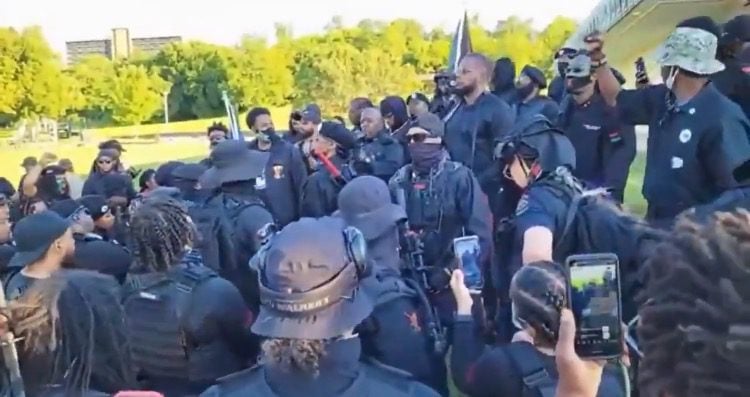
Black activists from the New Black Panther Party and other groups staged an armed march in Tulsa, Oklahoma on Saturday.
Organizers held a Second Amendment “March for Reparations” and marched through downtown Tulsa.
“The struggle for Reparations must be escalated,” a news release from
organizers read. “We must fight on every front to achieve redress and
Reparations for the atrocities committed upon Tulsa Massacre
descendants; and we must intensify the fight to achieve Reparations for
all 40-million Blacks still grossly affected by racism, inequality,
wealth disparity, police brutality and the like. Tulsa will mark a new
beginning in the upgraded fight for Reparations for Black people.”
Another supremacist threatened white people and said, “Because that time
will come when there’s a rat-a-tat-tat… black Americans will kill
everything white in sight.”
The following groups participated in Saturday’s march:
The Huey P Newton Gun Club (HPNGC)
The Elmer Geronimo Pratt Gun Club (EGPGC)
The New Black Panther Party for Self- Defense (NBPP)
The Fred Hampton Gun Club (FHGC)
The New Black Liberation Militia (NBLM)
The Panther Special Operations Command (PANSOC)
ANUBIS
Multiple other groups and private gun owners
Meanwhile, the FBI is busy hunting down grandmas who aimlessly wandered through the Capitol on January 6.
how many of you gave her your hard earned money so she could buy her THREE MILLION DOLLAR homes etc?
Black Lives Matter co-founder quits role amid controversy over $3m property portfolio
Verity Bowman
Patrisse Cullors poses for a photo - Amy Harris /Invision/AP
A
Black Lives Matter co-founder has resigned from her role as executive
director amid controversy over her $3m property portfolio.
Patrisse
Cullors, who founded the racial justice movement in 2013, is a
self-described “Marxist” but faced criticism after it was reported last
month that she owns four properties, including a $1.4m house in Malibu
and a ranch in Georgia.
The 37-year-old says she was the victim of
“right-wing attacks that tried to discredit my character,” and that her
resignation had long been planned because she has a new book and
television deal.
"I've created the infrastructure and the support, and the necessary bones and foundation, so that I can leave," she said.
"It feels like the time is right.
“I
don’t operate off of what the right thinks about me,” she added as she
denied that finances had any relation to her resignation.
Black
Lives Matter supporters and others march across the Brooklyn Bridge to
honor George Floyd on the one year anniversary of his death on May 25,
2021 - Spencer Platt /Getty Images North America
BLM
said she had "received a total of $120,000 since the organisation's
inception” following the 2013 acquittal of George Zimmerman, the
neighborhood watch volunteer who killed 17-year-old Trayvon Martin in
Florida.
This was for duties such as serving as spokesperson and engaging in political education work.
Claims
that she had misused donations to purchase property were strongly
denied and last month she told the Black News Channel that suggestions
of financial impropriety against her were "categorically untrue and
incredibly dangerous".
But she faced criticism from BLM organisers over the way she has spent her money.
“If
you go around calling yourself a socialist, you have to ask how much of
her own personal money is going to charitable causes,” Hawk Newsome, a
Black Lives Matter organiser, told The New York Post.
"It's really sad because it makes people doubt the validity of the movement."
BLM
collected $90 million in donations last year, as the movement hit the
global spotlight following the murder of George Floyd by police officer
Derek Chauvin, in Minneapolis.
The foundation spent a third of
that sum in 2020 on operating expenses, grants to black-led
organisations and other charitable giving.
But concerns have been raised as to how much of the funding was spent on racial justice programmes.
Activists
called for more transparency and said more should be given to the black
communities directly impacted by police brutality.
“That is the
most tragic aspect,” said the Rev T Sheri Dickerson, the president of an
Oklahoma City BLM chapter and a representative of the BLM10, a national
group of organisers that has publicly criticised the foundation over
funding and transparency.
“I know some of [the families] are
feeling exploited, their pain exploited, and that’s not something that I
ever want to be affiliated with.”
Ms Cullors and the foundation said that they support families without disclosing finances or making public announcements.
In 2018, Ms Cullors’ book "When They Call You a Terrorist: A Black Lives Matter Memoir” became a New York Times bestseller.
She
will release a second book, "An Abolitionists Handbook”, in October and
has a multi-year deal with Warner Bros to produce original content
centred on black stories.
The first of her TV projects will debut in July, she said.
"I
think I will probably be less visible, because I won't be at the helm
of one of the largest, most controversial organisations right now in the
history of our movement," Ms Cullors said.
"I'm aware that I'm a leader, and I don't shy away from that. But no movement is one leader."
As
she departs, the foundation is bringing aboard two new interim senior
executives to help steer it in the immediate future: Monifa Bandele, a
longtime BLM organiser and founder of the Malcolm X Grassroots Movement
in New York City, and Makani Themba, an early backer of the BLM movement
and chief strategist at Higher Ground Change Strategies in Jackson,
Mississippi.
"I think both of them come with not only a wealth of
movement experience, but also a wealth of executive experience," Ms
Cullors said.
Vaccine makers say immunity to the virus can begin to wane after six
or eight months. But more clinical data is needed, experts say
Pfizer's COVID-19 vaccine vials are seen at a mobile vaccination clinic in Los Angeles.
AFP via Getty Images
It looks like Americans may need to roll up their sleeves for a
COVID-19 booster shot, though vaccine makers and federal officials are
still trying to detect how long immunity to the virus lasts.
In the latest race to the regulatory finish line, Pfizer Inc.
PFE,
0.30%is testing its experimental COVID-19 booster shot in combination with its 20-valent pneumococcal conjugate vaccine in older adults, while Moderna Inc.
MRNA,
3.16%
told investors this month that a mid-stage clinical trial showed
its investigational booster can help protect against the serious B.1.351
and P.1. variants.
Moderna and Pfizer both developed two-dose, mRNA vaccines with similar rates of real-world effectiveness.
The COVID-19 vaccines developed by these companies, as well as the Johnson & Johnson
JNJ,
0.44%
shot — the third vaccine to be authorized in the U.S. — are all
considered very effective, especially when it comes to preventing
hospitalization and death, but it’s still unknown how long they can
protect people against the virus.
“We
do not have data on when to expect waning immunity leading to
breakthrough infections,” Dr. Stephen Hoge, Moderna’s president, told
investors, according to a FactSet transcript of a May 6 earnings call.
“But we do know that there is a raging pandemic, that reinfections will
happen at some point, and the best way to ensure that we do not have
renewed outbreaks in well-vaccinated countries is to boost and maintain
the highest possible levels of neutralizing antibodies.”
Moderna and Pfizer have recently said
immunity can start to wane between six to eight months after getting the
second shot of their vaccines. Dr. Peter Marks, a Food and Drug
Administration official, estimates that vaccine-induced immunity is
around one year, according to public remarks reported by CNBC.
“I
would project that it’s actually going to be longer than that,” Dr.
Mark Mulligan, director of NYU Langone Health’s Vaccine Center, said in a
May 3 interview. “It might be a year or even more. But in all
likelihood, for boosting of the magnitude of the antibody levels and
other immune responses, boosters will be needed.”
If SARS-CoV-2
becomes an endemic virus, as some medical experts have predicted,
boosters are one way to keep people protected and also address gaps in
immunity caused by powerful variants like B.1.351, first detected in
South Africa, and the P.1 first identified in Brazil that are thought to
lessen the effectiveness of these vaccines.
However, at this
point, it’s all speculation. There is no medical consensus about whether
booster shots are necessary to ensure continued protection against this
virus or even what the durability of immunity to this virus is.
“There’s
absolutely no evidence that we need a booster shot of anything,” Dr.
Carlos del Rio, an infectious-disease physician and executive associate
dean of the Emory University School of Medicine, said April 28. “The
most important thing to do is to get vaccinated right now. Whether
you’re going to need a booster shot, we’ll worry about that later.”
The case for-or-against booster shots
The
only data about the length of vaccine-induced immunity, which likely
takes into account antibody titer levels and T-cell response, is limited
at this time.
“We do not know precisely when we will need to
boost,” Dr. Anthony Fauci, President Joe Biden’s chief medical advisor,
said Tuesday during a White House briefing.
One study found that the Pfizer vaccine, which was developed with BioNTech SE
BNTX,
3.00%,
has a 91.3% efficacy rate
among clinical-trial participants six months after they got the second
dose. Other research indicates that people who are enrolled in the Phase
1 clinical study for Moderna’s vaccine still had antibodies six months after getting the second shot.
“It’s
likely that it’s not just a single booster but that this would be a
repeated event over the next several years,” Mulligan said. “If we
achieve broad enough vaccination to shut down virus transmission and
have the pandemic die out, great. But we’re so far [from] that right
now.”
About 39% of people in the U.S. are fully vaccinated, as of Tuesday, according to the latest data from the Centers for Disease Control and Prevention, though vaccination rates in the U.S. have been slowing for weeks.
Other experts disagree with the push for boosters, citing a lack of data.
Cornell University virologist John Moore recently told Axios
“it’s not proven that we need boosters yet. Whereas it’s appropriate to
plan for boosters, you’ve got to look at whether there’s a corporate
agenda behind this.”
Del Rio instead predicts a future in which
the U.S. will have the virus under control, and Americans may need a
COVID-19 booster to travel to certain countries, much like how a yellow
fever vaccine or booster is recommended or required for travel to
certain Central and South American and African countries.
“I
suspect that if there’s a variant in India, and you decide to travel to
India, you will be told, as part of your travel, you’re going to have to
take this,” he said.
Are boosters another billion-dollar opportunity for vaccine makers?
COVID-19
vaccines are already a booming business for drug makers, and boosters
are part of the corporate strategy going forward. (Moderna executives
mentioned their booster shot dozens of times on their most recent
earnings call.)
While
the U.S. government has not announced any purchases of COVID-19 booster
shots, other countries have. Australia, Israel, and Switzerland have
already inked deals with these drug makers to buy millions of booster
doses for 2022.
Pfizer anticipates it will get data for its
booster candidate in July, with plans to file for authorization that
same month and then get a regulatory okay in the U.S. sometime in 2021.
The
company is developing two types of shots: one functions like a third
dose of its currently available vaccine, aiming to boost immunity among
participants from its Phase 1 clinical trial in the U.S., and the other
uses a modified mRNA sequence. It announced the booster/pneumococcal
conjugate vaccine study this week.
Moderna is testing three types of boosters:
A booster that acts like a third dose to its original two-dose vaccine.
A booster that specifically aims to address the B.1.351 and P.1
variants. (Both of these variants are of particular concern to Moderna
and Pfizer because the companies ran their pivotal Phase 3 clinical
trials at a time before those variants had been identified as
concerning.)
A booster that is made up of a 50/50 mix of its original vaccine and the booster targeting the B.1.351 variant.
What about other vaccine makers?
J&J
has not yet shared any longer-term data about its vaccine’s immune
response, though executives have noted that the company plans to assess
whether there is a need to develop a booster.
However, some Wall
Street analysts have said it’s easier to develop boosters for mRNA and
protein-based vaccines than adenovirus-based vaccines like the J&J
shot. (Novavax Inc.
NVAX,
-2.03%
is an example of a company developing a protein-based COVID-19 vaccine candidate.)
SanofiSNY,
0.96%,
which has previously reported some delays moving its COVID-19
vaccine through development, recently hinted to investors that its
still-investigational single-dose COVID-19 shot may have more value as a
booster. The vaccine candidate is expected to move into Phase 3
clinical trials, and it will also be tested in a booster-specific study.
That said, boosters and vaccination in general doesn’t need to be a one-size-fits-all model for every single person.
The
U.S. could test out a different approach for booster shots that
evaluates an individual’s antibody levels to assess whether or not they
need a booster shot at all, said Dr. Michael Mina, an assistant
professor of epidemiology at the Harvard T.H. Chan School of Public
Health. This is because immunity shows up differently in different
people, based on factors like age and overall health.
“It would
be super easy to set up, and it could be voluntary,” Mina said. “Do you
want a booster? Do you want to see if you need a booster? To get there,
we would really want to start building correlates of protection,
meaning: what is the antibody level that we feel good as a physician or
as a public health agency saying, if you’re at this level, you’re
probably still protected.”
US soldiers 'revealed locations of nuclear weapons in Europe by posting details on online flashcards,' report claims
Jamie Johnson
A Dutch F16 at the Volkel Air Base - JEROEN JUMELET/AFP/Getty Images
American
soldiers have mistakenly revealed the exact locations of US nuclear
weapons in Europe by uploading details as part of revision exercises
that were publicly available to view, a report claims.
An investigation by Bellingcat alleges
that soldiers attempting to learn intricate security protocols uploaded
a multitude of sensitive information to the internet, including not
only the bases at which the weapons are held, but in which exact vaults
they are stored.
The US Air Force has launched an investigation into "the suitability of information shared via study flashcards."
Questions
and answers were written on flashcards, which have now disappeared, and
appeared to show the positions of cameras, the frequency of patrols
around the vaults, secret duress words that signal when a guard is being
threatened and the unique identifiers that a restricted area badge
needs to have, Bellingcat said.
The
cards had been uploaded as long ago as 2013 on websites including Cram,
Quizlet and Chegg, and accessed as recently as April this year. Some of
those sites have the visibility of the cards set to be viewed by anyone
by default.
The presence of US nuclear weapons in Europe acted as
a deterrent to the Soviet Union during the Cold War and also meant
European countries would not need to develop their own.
Various leaked documents have indicated that they use six sites across the continent.
“These
bombs are stored at six US and European bases - Kleine Brogel in
Belgium, Büchel in Germany, Aviano and Ghedi-Torre in Italy, Volkel in
The Netherlands, and Incirlik in Turkey,” one line read, according to
the Belgian newspaper De Morgen.
The Bellingcat report features
screenshots of flashcards indicating that soldiers are taught what to
shout to an intruder in the local language.
One card relating to
the 701st Munitions Maintenance Squadron shows a phrase to make someone
surrender weapons in Flemish, indicating that the security details in it
apply to Kleine Brogel air base, Belgium.
The most revealing
information, however, pertained to a “vault status” flashcard that
appeared to note which shelters at Volkel contain nuclear weapons.
Five were listed as “hot” and six as “cold.”
To further corroborate their story, Bellingcat unearthed a photograph on Facebook posted by someone associated with 703rd MUNSS.
It
is a large group photo showing more than 50 individuals wearing US
military uniforms posing beside a Dutch army vehicle and in front of a
nuclear warhead.
Using
geolocating technology and a leaked map of the site, it appears that
the soldiers are standing in front of vault 532 - which on the
flashcard, is listed as “cold.”
Dr Jeffrey Lewis, Director of the
East Asia Nonproliferation Program at the James Martin Centre for
Nonproliferation Studies said it would be highly unlikely for active
service members to pose with a live bomb.
Dr Lewis said that the flashcard information about the vault being “cold” is likely to be correct.
The information disclosure is a “flagrant breach” of security practices, he told Bellingcat.
“This is yet one more warning that these weapons are not secure.”
The Dutch ministry of Defence told Bellingcat: “This photo should not have been taken, let alone published.”
Hans
Kristenssen, director of the Nuclear Information Project at the
Federation of American Scientists, said: “There are so many fingerprints
that give away where the nuclear weapons are that it serves no military
or safety purpose to try to keep it secret. Safety is accomplished by
effective security, not secrecy.”
But some of the details which soldiers were trying to learn included how to authenticate security badges.
In
one screenshot, a flashcard detailed that ‘VOLKEL’ should be spelt
without the first L and that ‘MUNSS’ should be missing an S.
Another card allegedly details where the emblems and flags should appear on the security pass.
A
US Air Force Spokesperson told the Telegraph: “The Department of the
Air Force is investigating the suitability of information shared via
study flashcards."
(here we go...."Treat us equally" is no longer coming out the mouths...now it"s I think i'm superior to you and I DEMAND money,school,pay off my home, pay off my farm)
'You Can Feel the Tension': A Windfall for Minority Farmers Divides Rural America
Jack Healy
·9 min read
Shade Lewis feeds his cattle on his farm in La Grange, Mo., May 21, 2021. (Neeta Satam/The New York Times)
LaGRANGE,
Mo. — Shade Lewis had just come in from feeding his cows one sunny
spring afternoon when he opened a letter that could change his life: The
government was offering to pay off his $200,000 farm loan, part of a
new debt relief program created by Democrats to help farmers who have
endured generations of racial discrimination.
It was a windfall
for a 29-year-old who has spent the past decade scratching out a living
as the only Black farmer in his corner of northeastern Missouri, where
signposts quoting Genesis line the soybean fields and traffic signals
warn drivers to go slow because it is planting season.
But the $4
billion fund has angered conservative white farmers who say they are
being unfairly excluded because of their race. And it has plunged Lewis
and other farmers of color into a new culture war over race, money and
power in U.S. farming.
“You can feel the tension,” Lewis said. “We’ve caught a lot of heat from the conservative Caucasian farmers.”
The
debt relief is redress set aside for what the government calls
“socially disadvantaged farmers” — Black, Hispanic, Indigenous and other
nonwhite workers who have endured a long history of discrimination,
from violence and land theft in the Jim Crow South to banks and federal
farm offices that refused them loans or government benefits that went to
white farmers.
The program is part of a broader effort by the
Biden administration and Democrats in Congress to confront how racial
injustice has shaped U.S. farming, which is overwhelmingly white. Black
farm advocacy groups say that nearly all the land, profit and subsidies
go to the biggest, most powerful farm operations, leaving Black farmers
with little. But in large portions of rural America, the payments
threaten to further anger white conservative farmers.
The plans
have drawn thousands of enraged comments on farm forums and are being
fought by banks worried about losing interest income. And some rural
residents have rallied around a new slogan, cribbed from the
conservative response to the Black Lives Matter movement: All Farmers
Matter.
Lewis is part of a new generation of Black farmers
venturing back into urban plots and small rural farms, driven by a
desire to nourish their communities with healthy food and create wealth
rooted in the land.
Growing up in LaGrange, a city of 950 along
the Mississippi River, Lewis would scoot a toy John Deere tractor
through his mother’s apartment and pretend he was farming the carpet. He
joined 4-H, farming and business groups in high school. He started
farming at 19, with a few cows and dreams of ending the day with his own
dirt on the soles of his boots.
“I worried about him,” said his father, Kevin Lewis. “I watch him and shake my head and say, 'Is it worth it?'”
It
can be a tough, lonely life. In 1920, African Americans owned some 14%
of the farms in the United States. But after a century of racial
violence, foreclosures, migration into cities and farm consolidation,
there are fewer than 49,000 left, representing 1.4% of American farmers.
Most are concentrated in the Southeast and Texas.
These days,
Black farmers have forged online networks that function as their own
digital homemade farm bureaus. They celebrate first turnip harvests, ask
whether fertilizer made from fish can revive wilting plants and
commiserate about navigating government programs and the isolation of
being the only Black farmers in their counties.
“You don’t have a
network. You don’t have an infrastructure. There’s nothing,” said Sandy
Thompson, who started an online directory of Black farmers in 2019 after
abandoning a three-year quest to convert a 5-acre plot outside San
Antonio into a vegetable farm.
Thompson spent $20,000 on equipment
only to have her mower get stuck in the sandy soil. She called
university extension offices, a vital source of guidance for farmers,
but said she never got any help.
“We are not competitive with white farmers,” she said. “We need any help we can get.”
Nonwhite
farmers, who make up about 5% of farmers, say they struggle
disproportionately to get loans and government grants. They received
less than 1% of the billions of dollars in subsidies that flowed into
farm country last year under former President Donald Trump to compensate
farmers hurt by the coronavirus pandemic and the trade war with China.
Lewis
said he spent years struggling financially and searching for credit as
he built his cattle herd from a few cows on rented ground to about 200
cows and calves on more than 100 acres of his own land. At first, he
said, farm agents did not return his calls. Banks scoffed at his plans.
Some days, he could not afford to gas up the red pickup truck that would
stall out as he went to fix fences and spread manure in his alfalfa
fields. Like many farmers, he works a second job, on power transmission
lines.
Getting his government loan paid off now could change
everything. He said he could pay down other loans on his livestock,
expand the patchwork of fields he owns to compete against established
farmers, and get financing to build a home so he and his wife can escape
their one-bedroom apartment.
“It’ll open up a whole lot of
doors,” he said. “Maybe these local banks that didn’t have time for
minorities will open up to us.”
But several of his white neighbors in Lewis County, where 77% of voters supported Trump in November, see it differently.
Now,
raw conversations about discrimination in farming are unfolding at
farmers markets and on rural social media channels where race is often
an uncomfortable subject.
“It’s a bunch of crap,” said Jeffrey
Lay, who grows corn and soybeans on 2,000 acres and is president of the
county farm bureau. “They talk about they want to get rid of
discrimination. But they’re not even thinking about the fact that
they’re discriminating against us.”
Even in a county that is 94%
white, Lay said the federal government’s renewed focus on helping
farmers of color made him feel like he was losing ground, a sign to him
of the country’s demographic shifts.
“I can’t afford to go buy
that 5,000-acre piece of ground,” he said. “Shade Lewis, he’d qualify to
get it. And that’s fine. That doesn’t bother me. But I can’t.”
Lewis
senses the tensions when he swings into the gas station to get a
Mountain Dew before feeding his cows in the morning and when he scans
comments on Facebook or the news on RFD-TV, a kind of CNN for rural
America. Conversations with white farmers around LaGrange become
strained when they veer from corn prices to the challenges of being a
Black farmer in a white industry.
“You can sit here and talk about
race and things you’ve been through,” Lewis said. “They don’t
understand. They’ll never understand.”
Many farmers of color have
welcomed the debt relief, which was tucked into the $1.9 trillion
coronavirus relief act, as well as even more ambitious measures proposed
by Democrats to grant plots of up to 160 acres to Black farmers.
The
Agriculture Department has a long-standing series of programs to serve
socially disadvantaged farmers and estimates that nearly 16,000 will
have loans paid off that were made or backed by the government. The
agency has sent thousands of letters to eligible farmers and expects
that money could start flowing by early June.
But rural residents upset with the repayments call them reverse racism.
White
conservative farmers and ranchers from Florida, Texas and the Midwest
quickly sued to block the program, arguing that the promised money
amounts to illegal discrimination. America First Legal, a group run by
former Trump aide Stephen Miller, is backing the Texas lawsuit, whose
plaintiff is the state’s agriculture commissioner.
“It’s
anti-white,” said Jon Stevens, one of five Midwestern farmers who filed a
lawsuit through the Wisconsin Institute for Law and Liberty, a
conservative legal group. “Since when does Agriculture get into this
kind of race politics?”
Agriculture Secretary Tom Vilsack defended
the debt-repayment program at a White House briefing this month, saying
that earlier coronavirus relief had gone disproportionately to white
farmers. He also said the government had never addressed the cumulative
effects of years of racial discrimination against farmers.
“We
know for a fact that socially disadvantaged producers were discriminated
against by the United States Department of Agriculture,” he said.
“There is a very legitimate reason for doing what we’re doing.”
The
use of race in federal programs has been a subject of litigation for
decades, with a narrow majority of the Supreme Court deciding in 1995
that it is permissible only if the programs are “narrowly tailored” to
accomplish a “compelling governmental interest.” The courts have
generally held that institutions have a compelling interest in remedying
their own past discrimination.
Still, the lawsuits have sowed
concern and anger through networks of Black farmers. Some have spent
decades fighting unsuccessfully to get their share of legal settlements
over past discrimination by the Agriculture Department. Now they are
worried that the money set aside for debt repayment could get delayed
for years in legal challenges.
“We’re getting the short end,” said
John Wesley Boyd Jr., a Virginia bean and grain farmer who is also
founder of the National Black Farmers Association. “Anytime in the
United States if there’s money for Blacks, those groups speak up and say
how unfair it is. But it’s not unfair when they’re spitting on you,
when they’re calling you racial epithets, when they’re tearing up your
application.”
Lewis said he tries to look beyond issues of race
and has a white wife, white in-laws and white family on his mother’s
side. But ignoring race can be impossible in a small town like LaGrange,
he said. He hunts, fishes, holds conservative views and curses by
saying “son of a buck.” He has voted Republican in past elections, but
unlike most of his neighbors, he voted for President Joe Biden.
One
recent afternoon, a friend, Brad Klauser, who runs his family’s large
cattle and grain farm, swung by Lewis’ barn to catch up. As they talked
bills, rising fuel costs and sky-high land prices, the conversation
turned to the debt relief that only one of them was eligible to receive.
“Everybody
should have the same option,” said Klauser, who is white, leaning on
the flatbed of Lewis’ pickup. “Do you think you’re disadvantaged?”
“There’s
definitely disadvantages,” Lewis replied, saying that officials scoffed
when he first tried to get a federal farm loan. “They didn’t take me
serious.”
After Klauser headed home, Lewis thought about how the
two friends were both trying to reap a profit from the land. “Everyone
should have a chance at farming,” he said.
The Centers for Disease Control is now investigating potential heart
problems in young adults and adolescents following Covid-19 vaccination.
The CDC said the mRNA ‘vaccines’ produced by Pfizer-BioNTech are ‘potentially’ causing the problem.
The FDA authorized the Pfizer gene therapy jabs for children as young
as 12 earlier this month and now there are reports of myocarditis
(inflammation of the heart muscle) in teens.
The reports of myocarditis in teens is more common in males and typically occurs after the second dose of the jab.
CDC Director Walensky is pushing back and claiming there is no direct
link between the vaccines and heart inflammation or myocarditis.
Because it’s completely normal for healthy teens to have heart problems.
The Centers for Disease Control is investigating a small number of
young adults and adolescents who may have experienced heart problems
following a COVID-19 vaccine, though the agency stressed that it is
unclear the vaccine is responsible.
There have been “relatively few” reports of myocarditis and “most
cases appear to be mild,” but the COVID-19 Vaccine Safety Technical Work
Group said it felt the potential issue should be communicated to
providers.
The COVID-19 Vaccine Safety Technical Work Group discussed the issue
during a meeting on May 17 and the news was first reported by the New
York Times on Saturday.
The CDC noted that the rates of Myocarditis in young adults following
the COVID-19 vaccine “have not differed from expected baseline rates.”
Some doctors and health experts have also argued that
COVID-19 can cause Myocarditis and other heart damage, but this link is
still being studied.
Dr. Cole recently sounded the alarm on Covid jabs during a radio interview.
“We’ve seen more deaths from this shot than all vaccines in the last
20 years combined — and that’s just in the first 4 to 5 months,” the
Idaho doctor said during an appearance on Rose Unplugged 1320 WJAS.